
 PL
PL  EN
EN 
Do you sometimes have reflections about our Earth, the universe and human existence? Or I'll ask that question differently. Have you ever looked up at the sky at the stars and imagined the cosmos? Yeah, I guess so. Now imagine that you are in space and you are looking at Earth. You see a huge planet filled with life. In addition to the miraculously diverse flora and fauna, 400,000 plant species and a million species of animals, eight billion people live on Earth. Can you imagine that? More than 8 billion lives, and one of them is you. Isn't that a self-righteous thing? You are your whole world, and unification is only its billionth unit. If you ever stand in the Atacama Desert and look around after this unearthly and alienated place, you will understand why I have such reflections. But now let's go back to Earth.
Whenever I am traveling and discovering a new place, I wonder how it is possible that I am constantly amazed by something new. When it seemed that nothing will surprise me anymore, the next day something happens the opposite. I discover places where I haven't been yet, and again the same, delight at something I've never seen before.

I don’t think there’s a daredevil in the world who could say, “I’ve seen it all.” Because if you wanted to see everything with your own eyes, you would have to cross each ocean, climb to every mountain, dive into every depth and traverse every desert. I think life would be missing for that.
That's why today he wants to invite you on a journey to one of the most remote corners of the world. A place thousands of kilometers away from civilization where only truly stubborn explorers reach. To a place whose soil is similar to that of Mars. To the place where you look up, you’ll see the cleanest sky on Earth and billions of glossy stars.
I'm taking you to South America, to Chile where it never rains - in the Atacama Desert.
What makes this part of the world so interesting
I like to find interesting, characteristic and unique places. We have come to Chile to fulfill the dream of our lives, include Andy and go through a 12-day trek in Patagonia. But I'll tell you about it in another post. The number two on the list was the Atacama Desert. Why is that? That’s because it’s considered the most dry area on Earth. It never or almost never rains. Can you imagine that? During the year, on average, rainfall is 1 mm, and there are also places where there has been no precipitation at all since the measurements are carried out. Is it possible ? Yes, because the Atacama is located between the Andes and the Chilean mountains. These two very high mountain ranges capture all the rain clouds.

Atacama is unearthly and not jokes at all
According to recent research conducted by NASA scientists and engineers, the soil on Atacama is very similar to that on Mars. Microelements that are found in salt, partially covering the surfaces of the desert, recreate an environment resembling the environment of the red planet. You just have to look. What does that remind you of?
The most interesting places in Atacee

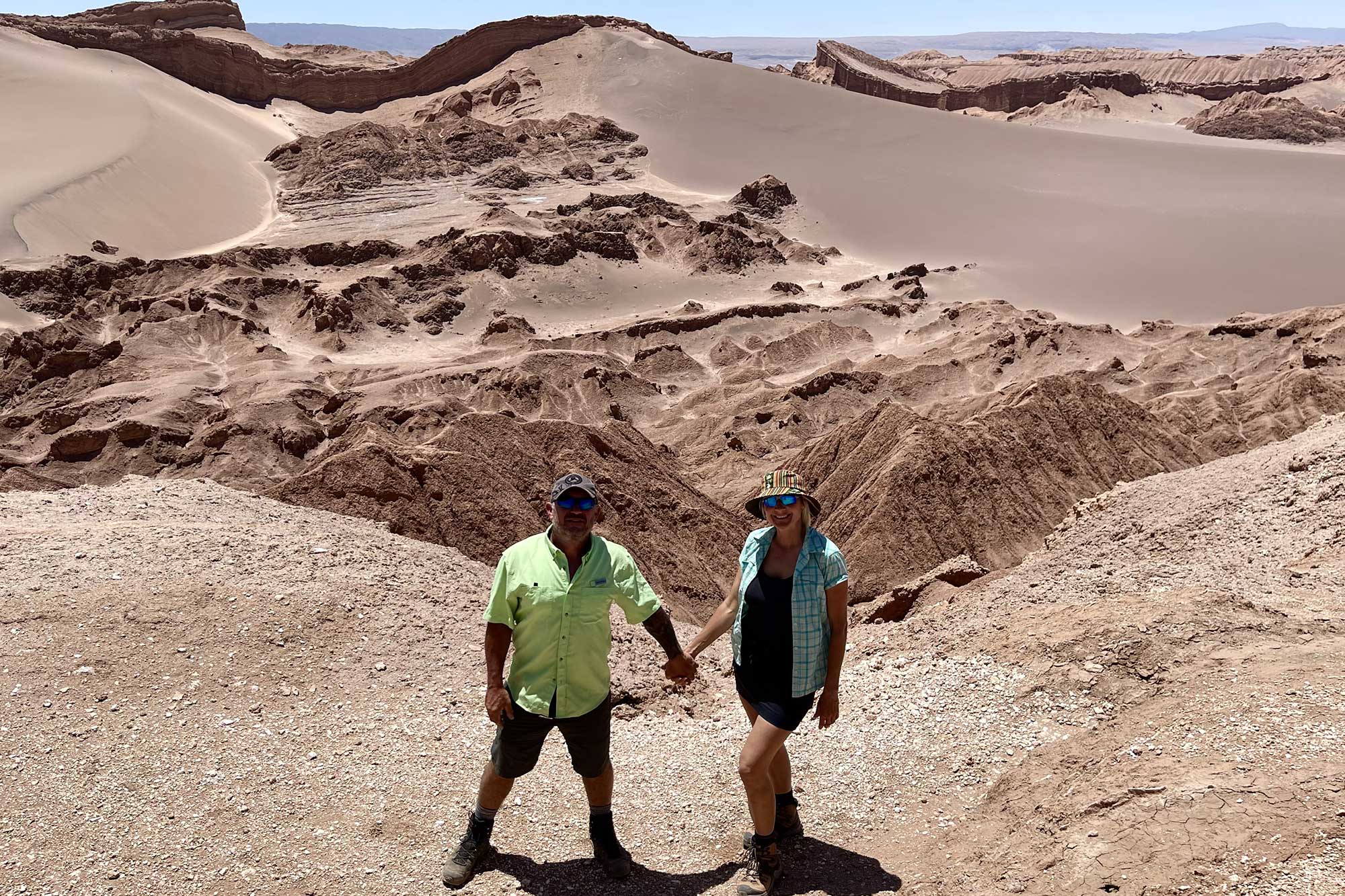
Valle de la Luna (Call of the Moon)
To explore the moon line, you can buy a trip at a travel agency or rent a car and go there yourself. As always, we chose option 2. The road from San Pedro to the lunar valley is 20 minutes long.
Tickets are priced at 10,800 CLP ($11) per person Ticket can be purchased online valledelaluna.com or on the spot. If you plan to buy tickets on site, you better buy cash. In case of lack of cash, there is an option to pay the card if you are lucky and the Internet works. We didn’t have the cash and we had to wait almost an hour.
The lunar valley stretches for 22 miles. At the entrance you will get a map where you will have the viewing points listed. With each foot you can get out of the car and allow yourself a small walk. I will emphasize the word “small” because it is super hot and without proper preparation I do not recommend a longer hike.

You need to see the MiradorAchachespoint of view . .
After a kilometer climbing in the hot sun without a gram of shadow to your eyes, a spectacular view will appear. Be sure not to convert from the first viewing platform, but to go further. Only there you will meet the reward in the form of fantastic formations.
Assuming that our walk will not last more than six minutes, I jumped out of the car and ran a path without water and a headgear completely unaware of the heat there. And that was a mistake. After a few minutes, you feel your body evaporated, and the collar turns into a dried plum. The sunlit light bounces off the sand, putting you in the eye, and the hot wind burns in the face.
And suddenly it is completely unknown where a beautiful, colorful, Colombian hat appeared from from my eyes. Under the influence of a gust of hot wind, he drifted alone on the desert ground. - Fatamorgana? Is it a dream? It was enough to go down for him 20 meters, which, of course, Kris immediately did. The hat fell from the sky and became my savior and then my inseparable friend to the end of the journey. Currently, he occupies an honorary place for a roller sult.

Los Flamenco National Reserve (flammable)
If you want to get a fool for a moment and enjoy the sight of wonderful pink flamingos, I invite you to the los Flamenco reserve. The reserve is only 1.20 minutes from San Antonio and was on our list of “must to see”. The flaming plant was promising. I've seen flamingos up close before, but never in nature. The reserve is divided into seven distinct areas, each providing a different scenery and landscape.

We traveled a kilometer by a kilometer admiring the views, it was on the right side on the right. The Flemings were nowhere. They have to be here somewhere. We're in the flamingos reservation. We reached almost the borders with Bolivia and the flamingos as it was not. We were in a secluded area and apart from us, there was no one there, not to mention flamingos. After a quick photo shoot, we went to the Salar de Pujs area. . Here we were greeted by the smell of rotten eggs and sulfur. Another photo session and disappointed with the lack of flamingos we decided to return to the hostel.
And just when everyone was losing hopes, they appeared. The Flaming National Reserve took pity on us and at the end of the day , he sent us a few flamingos to wipe away the tears .
There are flamingos! - At last!

The Licancabur Volcano
The Atacama Desert is home to about 150 volcanoes. Being in the Atacama Desert and not seeing volcanoes can be found. The iconic volcano is Licancabur, with a height of 5.916 m. Some of the volcanoes can even enter, but the prospect of many hours of treking at 40 C without a gram of shadow was not encouraging.

Gorge of the Devil
Visiting the Devil's Throat just after the moon valley was one of the biggest attractions in the Atacama Desert. Many people choose to explore by bicycle, we have visited this place on foot and not by choice, but because of Covid -19. Tourist agencies where you could rent bicycles were closed. The lack of tourists was basically the biggest attraction. We were there completely alone and wandering into the depths of the devil’s throat from kilometer to a kilometer we felt more and more explorers, like Indiana Joens.

Quebrada del Diablo is an 11-mile path (both side) that leads through narrow slotted canyons and huge red rock formations. At the end of the path, you can climb the viewpoint from which you will be able to admire the valley of Mars. It'll take you about 20 minutes.
As of today (summer 2024), the entrance ticket costs 5,000 CLP ($5.20) and can only be paid in cash. Bicycle rental prices are 7,000 CLP ($8.00)
The Valley of Mars
Continuing our series of adventures in the desert, we accidentally come across her hidden gem. Coming on Route 23 to the south of San Pedro, our attention was attracted by another fantastic place. We stopped the car to check it out and we couldn’t believe it. What we saw from the road was just a substitute for what was hidden deep into the ice. Before our eyes, they showed dozens or even hundreds of small rock formations in the shape of cones that formed an endless labyrinth. The non-earthly landscape and it is not surprising that this place is called the valley of Mars.

Viewpoint Kari, Coyota Stone
Kari's viewing point is a breathtaking tourist attraction. This place is located at an altitude of 2550m above sea level and is known as the “Coyota Stone”. It's a must-see stop where you'll make a unique photo session.

The Three Marie
Crossing the section of road 27, I look at the map and look at what else interesting we can see. We come across formations from salt rock carved by the wind and time. These are the figures of three women called “Three Marys. They are so realistic that it would seem, and they are the work of man. Unfortunately, today you can see them only from afar, because one of the characters has been overturned and destroyed by an unruly tourist. What a shame!
Tulor - ruins of ancient inhabitants
It is a must for lovers of history and archaeology. The village of Tulor was settled 2,500 years ago at the riverbed of the San Pedro River. This allowed the development of agriculture, animal grazing and pottery. Tulore is particularly interesting because of its unique architecture. It consists of circular structures built of mud combined by narrow corridors. The visit will be a short, but for the entrance ticket 2.900 CLP($3) you will get a guide who will briefly tell you the stories of its inhabitants. There is a reconstruction of two cottages, to which you will find invited inside.
What a relief, a little cold and a shadow!
I think the Atacama desert is hiding a lot of fantastic places. It is impossible to see everywhere and to preserve everything in memory. After a few days of being in a certain place, you begin to get used to it and the surrounding wonders of nature can be common to you. It's only when you get home to the big city and crowded streets that you're missing something. Then you will reach for the camera and with one click you will return to this fairytale land.
And so you create an idea and a plan for another trip into the unknown.

Atacama for Romantics and Astronomers
Once you get here, you will no doubt agree with me that this is a perfect place where your imagination will connect with the universe. It is here that evening you can observe the milk road without the use of telescopes. You'll look up at the sky and see billions of shining bright stars. This is because the desert area reaches 2,000 miles of mountain range without artificial light pollution. And from the place is extremely dry and there is no humidity, the sky remains completely exposed all the time. I can't believe it, but 300 nights a year is cloudless here.
Flora and fauna
To give the Atacama desert even more finesse, once every 5 to 7 years there may be little rainfall. Then one of the most stunning natural phenomena in the world will happen...the sea of wild pink purple flowers will happen, whose seeds lay dormant for many years. This phenomenon is obviously unpredictable, and so not many there are hikers who were lucky enough to see it.

Apart from this wonderful phenomenon, which I was unfortunately not lucky to experience, in the desert almost nothing grows. Where to look everywhere, only gravel and clear deposits of fossilized salt, packed with hot wind. At first glance, a land in which life does not exist. But there is nothing that nature can’t handle. There is nothing to look at the eye, but if you reach even further, you can see the wild-living Andean viking – the smallest of the camel family. These animals have perfectly adapted, cultivating negligible and invisible clumps of plants and lichens that appeared drawing water from fog and dew.


Other interesting places
San Pedro de Atacama: this will probably be your place of departure. It’s a small town in the desert that offers museums and travel agencies where you can buy a trip or rent a bike.
- ALMA Observatory: A state-of-the-art Observatory for Star Observation
- Rainbow Valley: A place where you can see hidden petroglyphs
- Piedras Rojas: A place where you can cross red rocks and look down on the salt plain
- Gysayers: El Tatio geyser are one of the highest geothermal fields
- Swamps and lagoons: The desert has swamps and lagoons, including the Miscanti Lagoons and Miiques
How to get to San Pedro De Atacama?
A plane to Calama Airport in Chile. From Calama you can take the Frontera del Norte Calama bus to San Pedro de Atacama. I always use the Romeo2Rio app where you search all the links. Buses depart every two hours Ticket price from 5,000 CL ($5) Travel time 1.5 hours .
You can also find a private bus that will take you from Calama Airport to San Pedro de Atacama. There is no specific departure time. They leave as soon as they are full. The price is fixed and should be 15,000 CLP ($18). The third option is to rent your car. Rental price is $30 per day
In our case it was a little different. After treking in Patagonia, we returned to the capital of Chile to Santiago. We had another week to use and we wanted to see as the last thing. Since our friend Sebastian accompanied us on this journey, we have gained another driver. After analyzing all the for and against, we decided to rent a car in Santiago and go to Atacama alone. The journey of 1650 km took us a day with small breaks. It is a painstaking, but at the same time the best solution, because you can stay anywhere and nothing will miss you along the way.
We are lucky...
If you decide to rent a car, remember to refuel the full fuel at every chance you keep up with, because you do not know where the next open petrol station will be. However, if the misfortune in the form of lack of fuel, the head up. Chile may surprise you. We have experienced this and there is proof that there is no situation without a way out.
We passed two closed gas stations and literally on the fumes we drove off the main road to the tiny village. Here we went for help at the police station, which was a small room in a private house. With the help of an interpreter on the phone, we were instructed to go to a few houses away from the store. The store turned out to be another private house, the front door of which was divided in half, and after opening the upper half, the lower half was a counter. Inside on the fields stood jars with content of not known what, fruits, vegetables and several cleaning products. But where is the fuel? The interpreter on the phone didn't work, but we got along the blinks. The seller had a moment to wait and then returned with plastic bottles full of fuel and a funnel. The rescue game!

How much time to spend on sightseeing
This, of course, depends on how much time you have and what you want to spend it on in particular. We spent three days here. If we had more time, I would have stayed one more day to tick everything off, but I think we have seen everything most important and interesting.
This, of course, depends on how much time you have and what you want to spend it on in particular. We spent three days here. If we had more time, I would have one more day to keep everything around, but I think we’ve seen everything that matters most and the most interesting.

Atacama and the coca leaves
The town of San Pedro is located almost 8,000 feet (almost 2500 m above sea level). Atacamy plateau reaches 13,000 feet (4,000 m above sea level) So, Atacama is really high, and dry air and desert climate do not help. If you have not experienced acclimatization from where you come, you may begin to experience symptoms of altitude sickness. These are dizziness and headaches, nausea and fatigue. It is best to spend two days on acclimatization and drink a lot of water, as this also provides oxygen to your body.
It is also very popular to chew coca leaves. This, in turn, you can find anywhere, it is sold on every corner or simply lies exhibited for general use in every hostel. Under the influence of chewing in the mouth, saliva is produced, which also provides oxygen to the brain. It is wrong to believe in the coke leaf, they are an intoxicant, only mixed with another chemical can cause the expected effect.
I've been dropping coke leaves in every pocket, but I chewed her little. The seasoned climber in the Andes I had no problems with altitude sickness in the desert. When I got home, I discovered my backpack from my backpack, stuffed to the banks of the leaves.
I don't have to explain myself to the officials at the border.
Facts and curiosities
- is the oldest desert on Earth
- is 15 million years old
One of the driest places in the world
- in the middle of the desert it never rained
- Atacama people speak in the already extinct language of Kunza
- temperature can reach 104 F (40 C) in day and 41F (5C) at night
NASA uses the Atacama Desert for all scientific experiments and to test the machines and instruments that are sent into space.
In 2028, the construction of the largest optical telescope on earth will be completed. The ELT will be a small mirror with a diameter of 39 m and will collect 100 million times more light